

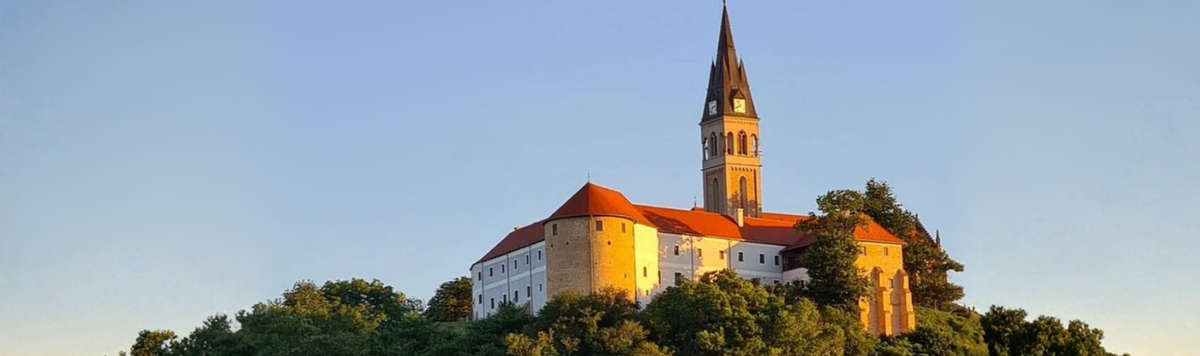
Nora left Vukovar, Croatia, when she was six months old and grew up in Nova Scotia, Canada, far from the large Balkan communities found elsewhere in Canada. She remembers almost nothing of the country she was born in, yet somehow knows exactly what home is supposed to feel like.
Nora doesn’t remember leaving Croatia. She was only six months old when her parents packed two bags, gathered up their baby daughter and boarded a flight to Canada. She would grow up in Halifax and Dartmouth, Nova Scotia, meaning nearly every childhood memory she carries was made on Canadian soil.
And yet, ask Nora where she’s from and there is absolutely no hesitation.
“I always enthusiastically reply that I’m Croatian.” Vogue pose included. She was born in Vukovar and returned with her family every year until she was four, then every few years afterward. Croatia remained part of her life, but much of what connected Nora to it had to be built from a distance.
Maybe that is why her relationship with home is so interesting. Canada is the country she knows best. Croatia is the country she carries in her heart.

Two Bags, a Baby and a Snowstorm
Nora may not remember her family’s arrival in Canada, but the story has been told enough times that certain details have become part of the family mythology. For one thing, Canada welcomed them with a massive snowstorm. Her parents arrived in Nova Scotia without speaking English, with barely any money and two bags. “One was just my stuff,” Nora points out.
They had left behind family, friends, pets and the familiarity of a life they understood for the possibility of something safer. Two years later, they would have another baby while still trying to establish themselves in a country whose language, climate and customs they were learning as they went. Her mother found certain freedoms in Canada that surprised her. Back home, she had felt pressure around how women were expected to dress and present themselves. In Canada, some of that pressure seemed to disappear. She could let her guard down a little.
Other adjustments took more time.The weather was awful, the bread was strangely sweet, and there was no Vegeta. For a Balkan family trying to rebuild its life on another continent, discovering that even the seasoning you instinctively reach for isn’t on the grocery-store shelf can make an unfamiliar country feel just a little more foreign.
For my mom, learning to cook without it, Nora says, was “rough.”Eventually her mother felt Canada had been the right decision. Her father never felt quite as certain. There is something revealing in that difference. Two people can make the same journey, build the same family and live in the same country while carrying completely different relationships with the place they left behind. Nora grew up somewhere between both of those perspectives.
The Things That Made Her Different
There wasn’t a large Croatian or Balkan community surrounding Nora in Nova Scotia. In fact, it often felt lonely and isolating. There were a few families from the former Yugoslavia whom her parents befriended, and those relationships became important. Visits gave the adults people with whom they could speak their language and remember home. For the children, they created a small circle where their families didn’t seem unusual.
Because outside of it, Nora was constantly reminded of how different she was. At home, her parents spoke Serbo-Croatian to her. Nora understood everything, although she usually answered them in English. She ate the food her parents cooked, absorbed their expressions and learned English partly through two people who were learning it themselves. At school, children noticed. They noticed her lunches. They noticed her clothes. They noticed the way she pronounced certain words because she had first heard them spoken in her parents’ heavy accents.They even had a name for her. “The Immi.” Short for immigrant.
In seventh grade, Nora once commented on the colour of another boy’s yellow sweater, remarking that it reminded her of mustard. His response was to tell her to go back where she came from. That stuck with her and childhood has a way of making seemingly small moments feel enormous. When you already know your lunch smells different, your parents sound different and your family does things differently, it doesn’t take much to reinforce the feeling that everyone else has been given instructions for how to belong that somehow never made it to your house.
Still, Nora never stopped wanting people to know she was Croatian. The difference embarrassed her at times. The identity itself did not.
How Do You Miss Somewhere You Barely Remember?

This is where Nora’s story becomes harder to explain. She hasn’t been back to Croatia since she was a teenager. Most of her life has unfolded in Canada. She knows she has picked up Canadian habits and ways of thinking, and her husband happily reminds her that she can be “very Canadian.” But when Nora talks about where she belongs, her answer doesn’t follow the arithmetic. “In my heart, I feel like I belong to Croatia.”
At the same time, she knows returning permanently would not be as simple as going home. “I know that I still wouldn’t fit in well back in Croatia because of so many Western traits that I’ve grown into.” That may be one of the strangest parts of diaspora identity: longing for somewhere while knowing that somewhere has continued living without you.
The place changes.You change. And the version of home carried inside a family can become its a place that only exists in your memories.
Nora experienced that recently while visiting Albania, where her husband is from. She wasn’t in Vukovar. She wasn’t even in Croatia. But she stepped into a Balkan village and recognized something. The feeling of home. “You’ve got the rooster crowing at 5 a.m., the little corner store that everyone knows you at, the Babas gossiping and sitting on their patio area in the shade, watching you walk by, waving and asking your life story, bribing yout to stop by with the smell of coffee and cigarettes, a plate of cookies and the scent of manure lingering in the air.”
Not exactly Chanel No. 5. But to Nora? “That’s home to me. A Balkan village.” Maybe that is why the feeling survived even when the memories didn’t. Home, for Nora, was never only a specific address. It was a rhythm of life her parents carried with them; the closeness between people, the food, the hospitality, the lack of anonymity, the sense that somebody’s Baba is always nearby and almost certainly knows more about your life than you do.
She misses the weather and the food, too. Especially food made from ingredients that somehow taste different there, no matter how faithfully the same recipes are recreated in Canada. But beneath all of that is something less tangible. She misses the way life feels. So much so that her dream is to move back one day and raise her own family there.
The Place That Helped Them Heal
Before that dream could take shape, Nora’s family found something they hadn’t expected in Ontario. After growing up in Nova Scotia, Nora moved to Hamilton in her late teens. Her family eventually settled in Stoney Creek, where relatives were nearby and the Balkan diaspora was suddenly part of everyday life.
There were Balkan grocery stores and restaurants, familiar foods that didn’t require improvisation. And perhaps most importantly, a community of people who understood where she was from. For someone raised with relatively little diaspora around her, these things might sound ordinary. To Nora’s family, they weren’t.
“I think that’s healed my family a lot.” she says.
Healed.
It is a powerful word for something as seemingly simple as being able to walk into a shop and find the food you grew up eating.But maybe that is exactly the point. Homesickness isn’t always dramatic. Sometimes it accumulates in tiny absences: the ingredient you can’t find, the joke nobody understands, the language you hear only inside your own house, the family members who live an ocean away.
And sometimes healing happens in equally small ways. A familiar product on a grocery-store shelf. A cousin living nearby. A restaurant where the menu doesn’t need explaining. A stranger speaking your language within earshot. Stoney Creek could never replace Croatia. It didn’t have to. It simply allowed Nora’s family to feel less far away from it.
What Her Parents Built From Almost Nothing

As a child, Nora saw the life her parents were creating. As an adult, she sees what it cost them to create it. Nora remembers how much they struggled while she was growing up. Today, the picture looks very different. Her parents have a house. They have good careers. They have community. They can travel back to Croatia, regularly, and are now in a position to send money back home.
The people who once arrived needing to rebuild everything can now help the people they left behind. “They’ve done so well,” Nora says. “I’m so proud to call them my parents.”
That pride complicates her desire to leave Canada someday. Because wanting to return to Croatia doesn’t mean she believes her parents made the wrong decision. Canada gave her family safety and opportunity. It gave her parents the chance to build what they have today. You can be grateful for the life immigration gave your family and still grieve what immigration took from it.
Both can be true.
The Culture Made It Through
Walk into Nora’s home today and you can see what survived the journey. Guests are not simply welcomed. They are hosted. Before anyone arrives, Nora stress-cleans a house that is already clean. Then come the cookies, snacks, coffee and drinks, because apparently allowing someone to sit in a Balkan home without immediately offering them three different things to consume is a violation of international law.
There is a cold storage room that actually serves its intended purpose, something Canadian families may simply use for storage is used for rakija, suvo meso, preserves and other staples. And hanging at every entrance is a ring of dried garlic. Her Croatian credentials remain strong.
Ask what the most Croatian thing about her is and Nora debates between her “full-blown Croatian/Balkan palate” and her temper. The palate might win. Fritule. Ćevapi. Seafood. Burek. Kulen. She refuses to pick a favourite because, according to Nora, Balkan food is simply “the best food in the world.” Case closed. Even her music refuses to stay neatly inside national borders. Croatian artists sit alongside Slovenian, Bosnian, Albanian and old-school Yugoslav music. For Nora, loving Croatia has never required pretending the cultures surrounding it are strangers. Which makes the person she eventually married rather fitting.
A Croatian Girl and an Albanian Guy Fell in Love
Nora had a feeling she would eventually end up with a Balkan man. And then she met an Albanian and the rest is history. The relationship did not exactly begin as a Balkans-united success story. Her now-husband initially wasn’t sure about dating her. She was Croatian, she had family in Serbia, he was Albanian, and he worried about how his family might react.
So at first, he wanted nothing to do with it. Fast-forward a few years.His family adores her. They got engaged and married a few months later. What Nora discovered while dating was that shared culture mattered to her, but not necessarily shared nationality.
She had dated outside the Balkans and realized that some parts of her upbringing were difficult to continually translate. She wanted someone who understood certain family dynamics, traditions and values because he had lived some version of them himself. Her husband’s culture isn’t hers. But he understands the language underneath it. And there is something hopeful in that too: two people inheriting complicated histories from the same region and choosing to build something together that belongs to neither history alone.

Maybe Home Is a Feeling Before It Is a Place
Nora still dreams about Croatia. She imagines moving back and starting a family there, trading the life she knows for the village life she misses despite never truly having grown up in it. But she is also self-aware enough to know that the Croatia she longs for and the reality of living there may not be identical. “The grass is always greener on the other side,” she says. Maybe it is. But Nora’s story suggests that home was never going to be as simple as choosing one side anyway.
Her parents crossed an ocean to give her a different life. And, the life they left behind crossed with them, morphed and blended into something of its own; a culture of mixed emotions and mixed identities that grew into what she calls life today.
Nora’s story teaches us that memory isn’t the only way we inherit a place.


