

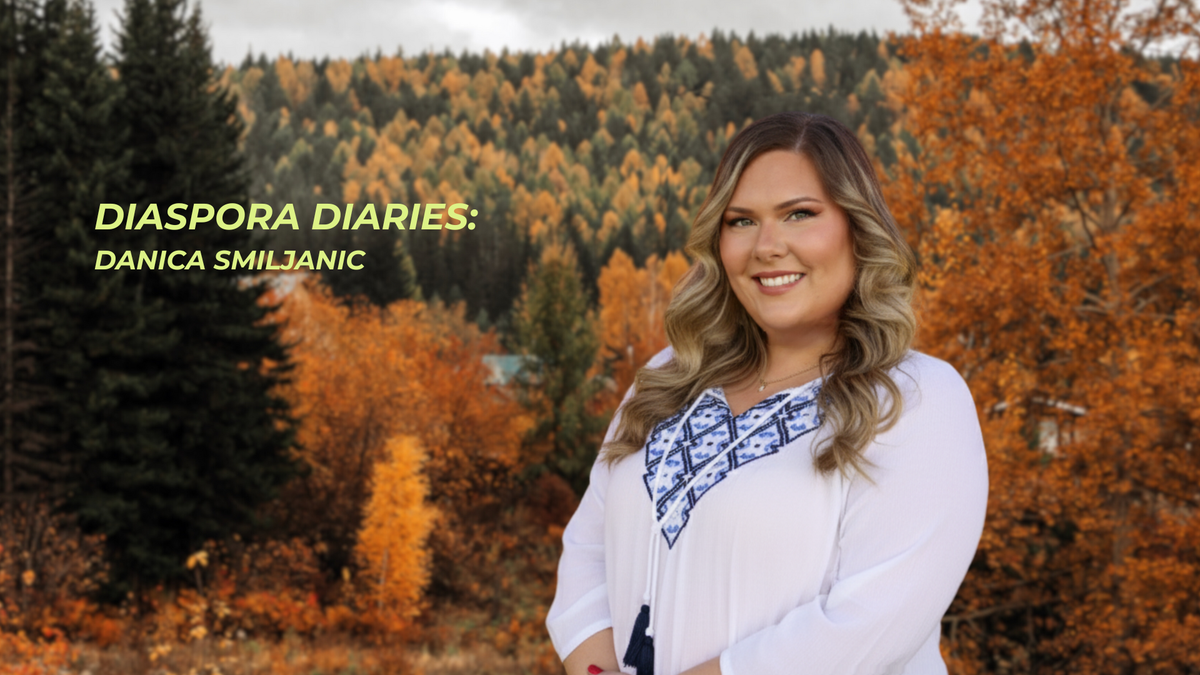
Diaspora Diaries: Danica Smiljanic, Somewhere Between Sarma and Wonder Bread
Growing up between cultures often means wanting two contradictory things at once: to fit in and to never forget where you came from. For Danica Smiljanic, it meant Serbian at home and English outside of it.
There is a particular kind of negotiation that happens when you grow up in the diaspora. You learn early that the version of “normal” inside your house may look very different from the one waiting outside your front door.
The Culture That Wouldn’t Let Me Forget
My parents did an incredible job preserving my Serbian roots. Despite the moments when being Serbian made me feel singled out at school, I genuinely loved who we were.
My brother and I grew up celebrating slava, going to church, dancing folklore, reciting old Serbian poetry for Sveti Sava, fasting before religious holidays, speaking the language and eating the food. Car rides to school were filled with the sound of us singing along to Zdravko Čolić, Marinko Rokvić or Lepa Brena. I loved helping my mom prepare for slava and watching the house transform as the food came together and family arrived.
In fact, despite both of us being born in Canada, my parents sent my brother and me to kindergarten without knowing much English at all. Their philosophy was simple: We’ll teach them what school can’t. They’ll learn the rest there.
And we did…Although I still remember coming home from school crying to my mom because nobody understood me.

Looking back, I realize my parents weren’t trying to keep Canada out. They knew Canada would find us. English would come through school, friends, television and simply growing up here. What required intention was making sure Serbian came with us too.
Still, being a kid means wanting to fit in.
Sometimes, I wanted a peanut butter sandwich on Wonder Bread instead of Mama’s sarma. Sometimes, I wanted my Canadian friends to understand why I loved Zdravko Čolić as much as whatever was playing on the radio. And sometimes, I just wanted being Serbian to require a little less explanation.
That didn’t mean I loved my culture any less. I simply hadn’t figured out how to carry both identities at the same time.
Different Rooms, Different Versions of Me
For many children of immigrants, identity becomes something you learn to adjust depending on the room.With my Canadian friends, I was Canadian. With my Balkan friends and family, I was Serbian. For years, the two versions of me existed beside each other without ever quite becoming one. The irony is that I came from a family that had spent generations making sure our culture survived.
My father was born in Lika, Yugoslavia, now Croatia, while my mother was Serbian but born and raised in Toronto. What made my upbringing unusual wasn’t simply having one immigrant parent and one Canadian-born parent. It was that my mother had grown up at the very centre of Toronto’s Serbian community.
Her parents came to Canada from Yugoslavia after the Second World War. My grandfather had survived a concentration camp, protected his homeland and eventually found himself building a new life abroad. With that new life came a freedom he did not take lightly. He believed that if he had survived everything he had, he owed it to himself to do something meaningful with that freedom.
So he started a Serbian radio program.
My grandparents became fixtures in the community. There were choir festivals, igranke, church events, fundraisers and cultural gatherings. Their radio program shared news from back home alongside stories and happenings from Serbian diaspora life in Toronto. They understood something immigrant communities have always understood: when you live far from home, familiar music, language and voices can become a lifeline.
Everyone seemed to know my grandparents. (You can read more about them here)
To put that into perspective, when my mother got married to my father, nearly 800 people attended their wedding. Yes, 800. If that doesn’t qualify as being well connected, I’m not sure what does. For my grandparents, community wasn’t something they participated in occasionally. It was part of the architecture of their lives. Without realizing it at the time, I was growing up on the foundation their generation had built.

The Question My Deda Left Me With
When my Deda sadly passed away in 2020, hundreds of people came to honour him, even as COVID was beginning to change the way the world gathered. I had always known my grandparents were important to their community, but grief has a strange way of allowing you to see a life in its entirety. Suddenly, I wasn’t just looking at my grandfather. I was looking at decades of commitment to his family, his culture and the community he helped build.
And I found myself thinking: How could I have this extraordinary example of dedication to our culture in front of me and do nothing with it? What would my contribution be? I didn’t have the answer yet. I only knew that if my grandparents had found their way to serve their generation of the diaspora, I wanted to find a way to serve mine.
“Znam da nije naš, al’ je moj.”
The answer began revealing itself a few years later, in a place I didn’t expect: while planning my wedding. Like many people in the diaspora, I fell in love with someone outside my culture. It wasn’t something I had imagined for myself growing up, and there had always been an expectation that I would marry Serbian.
When I first told my dad about our relationship, he went quiet. I knew exactly what he was thinking, so before he could say anything, I said:“Tata, Znam da nije naš, al’ je moj.” I know he isn’t one of ours, but he is mine. My dad softened and without a world more than “razumjem”, from that moment, he accepted the man who would become my husband as one of the family. Love was love. And ironically, marrying outside my culture would become part of what brought me back to it.
The Kolo I Hadn’t Danced in Years

I had always known I wanted a Big, Fat, Serbian Wedding. So when the planning began, I went looking for everything that would make it feel like one: trubači, harmonikaši, a Serbian-Canadian DJ who could get both sides of the wedding onto the dance floor, roast pig, meze, an Orthodox ceremony—the music, food and beautiful chaos I had grown up associating with a proper celebration.
And somewhere in the middle of planning all of it, I had an uncomfortable realization: I couldn’t remember the last time I had danced kolo. This was something that had once been part of nearly every celebration in my life. I had danced folklore from the age of five until eighteen. How had years passed without it? That question opened the door to others. When was the last time I had visited family in Serbia? When was the last time I had gone to church? When had things that once felt so ordinary become things I only reached for on special occasions?
I hadn’t made some dramatic decision to walk away from my culture. Life had simply gotten busy. I grew up, built a career and got swept into the momentum of adulthood until one day I realized I had stopped noticing how far away from some of it I had drifted. And suddenly I thought about the little girl who had once learned that telling people where she came from could make an entire classroom stare at her. Now here I was, planning a wedding where I wanted my Serbian identity to be impossible to miss. Somewhere between those two versions of myself, something had changed.
I Never Had to Choose
It wasn’t until my late twenties that I finally stopped feeling as though I had to choose.
Today, I can be unapologetically Balkan listening to turbofolk, celebrating slava and living for kafana culture while also letting the dog sleep in the bed, cottaging, Timbits and Canada Day. One does not cancel out the other.
I can celebrate two Christmases. I can dance kolo and feel completely at home in Canada. I can carry the traditions of my ancestors without pretending their experience is exactly the same as mine. Maybe that is what took me so long to understand. My grandparents built their version of diaspora. My parents gave me the language, traditions and roots they were determined I wouldn’t lose. And now I get to decide what carrying those things forward looks like for me.
That realization would eventually become part of the reason Maria and I created Balkanish. Because I know I’m not the only person who has lived between these two worlds. I’m not the only one who has felt too Canadian in one room and too Balkan in another, or wondered whether embracing one side somehow meant betraying the other.
It doesn’t.You are allowed to embrace both sides of your diaspora identity. You don’t have to choose between the country that raised you and the culture that raised you.
Somewhere between the two is a version of home that belongs entirely to you.
Diaspora Diaries
Diaspora Diaries is a Balkanish series sharing the stories of the global diaspora community—the people growing up between cultures, languages and definitions of home. We tell these stories because family histories deserve somewhere to land, and because sometimes the most powerful reminder that we belong is discovering that someone else has felt exactly the same way.


