

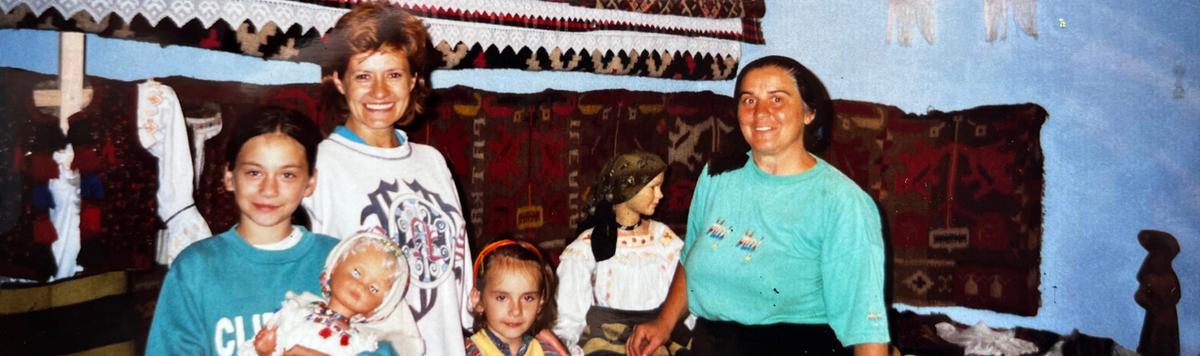
A story of leaving Romania at eleven, finding home in two countries, and turning an in-between identity into Balkanish.
About Maria & Balkanish
My name is Maria Enache, and I’m the Romanian Co-Founder of Balkanish.
Together with Danica, I started Balkanish to create the kinds of products we wished we had seen while growing up in Canada: pieces that feel modern and fun but are still rooted in the food, humour, language and memories that shaped us.
For me, Balkanish is deeply personal. I was born in Romania and moved to Canada when I was eleven and a half, which means my life has been split almost evenly between two countries. My foundations were built in Romania, but so much of the person I became was shaped in Canada.
For a long time, I didn’t know exactly what to call that identity. Romanian never stopped feeling true, but Canadian became true too. Balkanish grew from that space in between, and from realizing how many people across the diaspora have spent their lives trying to explain the same feeling.

Roots & Childhood
I was born in Ploiești, Romania, and spent most of my childhood between Ploiești, where my paternal grandparents live, and Alexandria, where my maternal grandparents lived.
Large parts of my summers were also spent in Plopu, la țară, where my grandfather built a little vacation home. It became a place where our family and friends could gather for weekends, and some of my happiest childhood memories were made there.
When I think about growing up in Romania, I think about summers first.
The days were simple, but they were always completely full. Most mornings began with my friends standing outside and yelling my name. That was my cue that the day had started. From the moment I woke up until the moment I went to bed, I was usually outside playing or walking around with friends. I barely wanted to come inside to eat because there were simply too many important things happening outside.
One of my favourite things to do was walk to the corner store with my friends so we could each buy a small bag of sunflower seeds. We would eat them as we walked around the neighbourhood with nowhere particularly important to be.
I also remember putting Atomic TV on and dancing around our apartment or my grandparents’ house while watching music videos. At our place in Plopu, I made another group of friends and spent a significant amount of time being chased by geese.
I was never a fan of the geese. The feeling was apparently mutual.
My childhood memories are also closely tied to smell. My grandparents lived near an oil refinery, and its very specific smell is permanently embedded in my brain. It may not sound particularly nostalgic, but to me, it means I’m close to their house.
I remember the distinct smell of my tataie’s Dacia and the walnut trees outside. Every fall, we would throw rocks at the branches to knock the walnuts down, then crack them open with more rocks and eat them fresh. I ate so many walnuts growing up. I also remember the scent of the original Nivea cream my grandmother applied every night. Whenever I stayed at her house during the summer, the scent seemed to follow her, filling every room she walked into.
Most of all, I remember my grandmother’s tartă cu vișine. My grandparents had three sour cherry trees in their front yard, and she would send me outside to pick the fruit for my favourite dessert. To this day, when that tart is baking, I think it is one of the best smells in the entire world.
Leaving Romania at Eleven
My family moved to Canada on October 25, 2003.
I understood that my parents were looking for a better life and more opportunities for all of us. They had been preparing me for the move long before we left, including enrolling me in weekly English lessons for two years.
I felt a mixture of everything. I was excited to experience something new, but I was also deeply sad to leave my life in Romania. Eleven is a strange age to immigrate. You are still a child, and adults assume you will adjust quickly. But you are also old enough to have already built an entire little life.
I had close friends at school, friends in my neighbourhood and another circle near my grandparents’ house, where I spent my summers. I was doing very well in school, and I still remember one of my teachers saying that my leaving would be “a huge loss.”
Before I left, my friends wrote me letters, sealed them and told me I was only allowed to read them once I was on the plane.
Safe to say, it was a sad plane ride.
I was sad to leave, but I was also curious about the life waiting for me in Canada. My childhood did not end when I left Romania. It continued in a new country, while the first half stayed with me.

Starting Over in Canada
Our family first settled in Windsor, Ontario.
My first impression was that Canada seemed very big, very clean and a little bit like something from a movie. We arrived just before Halloween, which wasn’t celebrated in Romania at the time. I could not understand why strangers were opening their doors and handing free candy to children. It felt completely surreal.
I had a very strong Romanian accent and wasn’t comfortable speaking English, but I pushed myself to compliment someone’s Halloween decorations by saying, “I like your house.” It wasn’t exactly a groundbreaking conversation, but I was very proud of myself.
I was also introduced to Dollarama and briefly believed it was the coolest place on Earth. Back then, everything actually was a dollar.
Before moving, I thought my English was fairly good. I had done well in my lessons in Romania, especially with grammar. But my teacher spoke English with a Romanian accent, and nothing prepared me for how quickly Canadians spoke. I understood English on paper. Following a real conversation was completely different.
For a while, I became afraid to speak because I worried that I wouldn’t be able to keep up. I naturally gravitated toward the other Romanian girls at school, and they became my first friends. It was comforting to have people around me who spoke my language, although speaking Romanian to one another all day probably didn’t help our English improve very quickly.
In Romania, I had just started Grade 5. Because of my age, my Canadian school placed me midway through Grade 6. Everyone thought I was a math genius because I could solve large equations in my head. Much of what my class was learning in Grade 6, I had already learned years earlier in Romania.
Math was easy. English, not so much. There were many small moments that reminded me I was the new immigrant kid.
In Romania, my family wrapped sandwiches in white napkins. We didn’t use paper or resealable bags. One day at lunch, another student asked whether my sandwich was wrapped in toilet paper. I didn’t know what “toilet paper” meant, so I nodded. Everyone laughed. After that, I started begging my mom to buy paper sandwich bags so I could bring my lunch to school the same way everyone else did and fit in.
A few months after arriving, I won a school award for a drawing I had created for Black History Month. When I was presented with it, a cute boy in my class shouted, “Go Romania!” to cheer me on. I wasn’t familiar with that kind of expression yet. I thought he was telling me to go back to Romania. I felt sad about it for quite a while until, one day, the meaning finally clicked.
Like many immigrant families starting again, we also struggled financially during those early years. For a while, we did much of our shopping at Value Village. Thrifting is cool now, but back then, it felt very different. One day, an older boy from my school saw me leaving the store and told everyone that I wore second-hand clothes. After that, I didn’t want to go back. When I did, I would wear a hood and hope nobody recognized me.
At eleven, moments like that felt enormous. As an adult, I understand them differently. I’m proud of how hard my parents worked and how much they built from those early beginnings. Starting over required sacrifices I was too young to fully recognize at the time.
Growing Up Between Two Worlds
At home, we spoke Romanian and ate mostly Romanian food. Outside our house, I was learning how to be a Canadian kid.
Later, when we moved away from Windsor, I attended a school with no Romanian students. Windsor had a large Romanian community, and until then, I had always found my way toward Romanian friends.
Without that community around me, I became more distanced from my Romanian identity during high school. I don’t think it was something I consciously chose. It simply became a quieter part of my life because there were fewer people around me who understood it.
But it never disappeared.
I still listen to Romanian music all the time. I still count in Romanian, and when I spell a word aloud, I often go through the letters in Romanian before translating them into English. At least once a day, I’ll be speaking one language and only remember the word I need in the other.
Sometimes I feel very Romanian in Canada and very Canadian in Romania. But I no longer see that as something I need to resolve. I consider myself Romanian-Canadian because both identities are part of me. Romania gave me my roots, my earliest memories and the foundation of who I am. Canada gave me a second home and shaped the adult I became. I am grateful for both.

Returning to Romania
Two years after we moved, my parents sent my sister and me back to Romania for the entire summer.
Returning felt surreal, almost like stepping into a memory or visiting another planet. At first, everything seemed slightly strange. Then the familiar smells returned, I saw my friends again and everything slowly began to feel right.
That first trip was also emotional because my great-grandmother had passed away only a few months earlier. We had been extremely close when I was growing up. Before she died, I wrote her a letter. Life and school became busy, and I never mailed it. I still have it, and not sending it will always be a big regret.
My parents continued sending my sister and me to Romania for long summer visits every few years. Those became some of the best summers of my life. They allowed me to maintain my relationships with my grandparents, friends and the country itself instead of letting Romania become only a childhood memory.
Even now, every time I return, it feels like stepping into another world. Romania is familiar to me in a way that is difficult to explain, but I also know I have changed.
Do I still belong there? Yes and no.
Canada is home. Romania is home. Leaving either one means missing something about the other. But, the hardest part of every trip is saying goodbye to my grandparents. I have been close to them my entire life, and leaving never gets easier, no matter how many times I do it.
Maybe that is dor: loving a place and its people so deeply that part of you misses them before you have even left.
The Balkanish Journey
I met Danica in first year university, shortly after we had both returned from spending our summers in the Balkans. Even though I am Romanian and she is Serbian, we connected over our shared Balkan backgrounds almost immediately. The details were different, but so much of the experience was the same: the food, the family dynamics, the music, the humour and the feeling of living somewhere between two cultures.
For years, I had wanted to create something that honoured where I came from. Balkanish eventually became that something. It allowed me to combine two things I have always loved: being creative and giving gifts.
Gift-giving has always been my love language. I love searching for the perfect gift, thinking outside the box and surprising someone with something that feels as though it could only have been chosen for them. Everyone who knows me also knows how seriously I take Christmas.
I have always been creative, too. Watching those two parts of me come together through Balkanish has been one of the most rewarding experiences of my life. It still feels a little crazy when someone buys one of the random, silly ideas Danica and I come up with, whether they’re buying it for themselves or giving it to someone they love.
But those ideas aren’t random to the people who understand them. They come from the phrases our families repeat, the foods we grew up eating, the songs that transport us to another time and the jokes that require no explanation inside a Balkan household.
Building Balkanish has made me feel closer to my Romanian identity than ever before. It has also shown me how many experiences we share across the Balkan diaspora, even when we come from different countries.
One customer once left us a review thanking us for creating gifts that reminded her of home. That brought a tear to my eye.
It was one of the moments that made me realize Balkanish had become more than a store. Our products were giving people a feeling of recognition, something familiar they could keep for themselves or give to someone who would immediately understand.
When someone discovers Balkanish, I hope our designs make them smile and think of home. Even if they have never lived in the Balkans themselves, I hope they feel a sense of warmth and familiarity.
We put so much thought into every design. Somewhere among all our crazy, silly ideas, we hope everyone finds at least one that makes them say, “That’s so me,” or better yet, “That’s my family.”
The Very Romanian Parts
After more than two decades in Canada, there are certain Romanian habits I will clearly never outgrow. I cannot walk around indoors without slippers, socks or sometimes both. I own, and will always own, a bag full of other bags. I sleep with a maieu on. I listen to Romanian music regularly, and my comfort meal will always be sarmale.
Choosing one favourite Romanian food is nearly impossible. Sarmale are number one, but I also love mâncare de mazăre cu frigănele, supă cu găluște, ardei umpluți and, very importantly, papanași. I was a picky eater growing up and refused to try salată de vinete until I was well into my twenties because I didn’t like how it looked. It is now one of my favourite foods in the world. I believe that is called personal growth.
Piftie, however, is still a no.
My favourite Romanian expression is Doamne fere, because it works in almost every situation. As for my favourite Romanian swear word, I can’t reveal all my secrets. But don’t make me angry while I’m driving.
Romanian music has also remained a constant in my life. It is almost impossible to choose one favourite song, but Dă-mi nopțile înapoi by A.S.I.A. will always be a classic for me. One of my more recent favourites is Cetera by Feli.
And then there is dor. The word has an English translation, but it never feels quite complete. Dor is more than missing someone or somewhere. It is a longing that carries love, memory and distance inside it. Dor de casă is something I think I will always experience, although, for me, acasă can now mean two different places.

Looking Ahead
My experience in the diaspora has taught me that identity does not need to fit neatly into one box.
You can be grateful for the life your parents created in a new country while still missing the one you left. You can feel at home in Canada and feel something completely different, but equally powerful, when you land in Romania. You can change without losing your roots.
I am incredibly grateful to my parents for having the courage to begin again. Their decision gave my sister and me opportunities and a life that I value deeply. It also gave me a perspective I would never have gained if I had known only one country.
I grew up with two cultures, two languages and two versions of home. There were confusing and difficult moments, but there was also so much gained.
Today, I’m proud of the eleven-year-old girl who was afraid to speak English but still found the courage to tell a stranger, “I like your house.” I’m proud of the Romanian-Canadian woman she became. And I’m proud that, through Balkanish, I can create something that helps other people feel understood in all the complicated, funny and beautiful parts of living between cultures.
I left Romania carrying handwritten letters from my childhood friends.
More than twenty years later, I’m still carrying Romania with me. Only now, I have found a way to share it.
Diaspora Diaries
Diaspora Diaries is a Balkanish series sharing the stories of the global diaspora community—the people growing up between cultures, languages and definitions of home. We tell these stories because family histories deserve somewhere to land, and because sometimes the most powerful reminder that we belong is discovering that someone else has felt exactly the same way.


